







By Andy Ridout, Founder and Managing Director of Advance TRS.
Having spent more than two decades working across engineering and infrastructure recruitment, one thing has always been clear to me: many of the UK’s largest infrastructure programmes depend heavily on some of the smallest businesses in the supply chain.
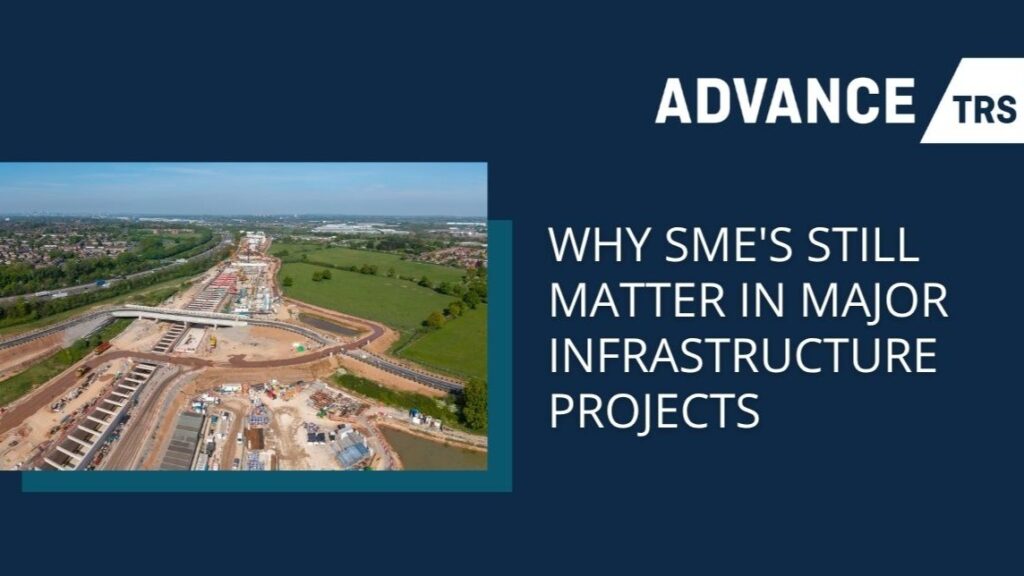
Major national programmes such as HS2, energy grid upgrades, airport expansion and rail modernisation involve vast delivery organisations and Tier-1 contractors. But much of the specialist expertise required to deliver these projects often sits within small and medium-sized enterprises (SME’s)























These businesses frequently provide highly specialised capabilities in areas such as geotechnical engineering, environmental consulting, surveying, digital engineering, and systems installation. In many cases, they are solving the highly technical challenges that sit at the heart of major infrastructure delivery.
The scale of SME involvement is often underestimated. For example, HS2 Ltd has reported that more than 70% of businesses in its supply chain are SME’s, with over 2,500 small businesses contributing to the programme. That reflects something many of us working across infrastructure already recognise, even the UK’s biggest projects rely heavily on smaller specialist suppliers.
At the same time, there remains an opportunity to increase SME participation in public procurement.
SME’s make up 99.9% of UK businesses and employ around 61% of the private sector workforce, yet they receive a much smaller share of public sector contracts. Analysis from the British Chambers of Commerce shows that SMEs received around £45.4 billion in government procurement spending in 2024, representing roughly 20% of total public procurement expenditure.
That sits well below the UK Government’s long-standing ambition that 33% of public procurement spending should go to SMEs, either directly or through supply chains.
From where I sit in the industry, this reflects a difficult balancing act within procurement systems. On one hand, frameworks and financial thresholds play an important role in managing delivery risk, although they can sometimes present challenges for smaller specialist businesses.

Common challenges SME’s face include complex framework bidding processes, strict financial thresholds, and procurement systems that rely heavily on structured digital responses. These mechanisms are designed to create fairness and consistency, but they can sometimes make it difficult for smaller suppliers to demonstrate specialist capability or innovative solutions.
This matters because SME’s bring qualities that are increasingly valuable in large infrastructure projects: specialist expertise, agility, and the ability to innovate and deploy quickly.
SMEs often operate with leaner structures and can scale resources directly in response to project demand. Instead, they recruit and scale in direct response to client needs, building teams around specific project requirements rather than deploying pre-existing resources that may not be ideally suited. This creates a more efficient operating model with lower overheads and allows SMEs to grow in alignment with project demand.
This model also enables faster mobilisation. By recruiting to defined project requirements rather than reallocating internal resources, SMEs can often deploy talent more quickly, improving speed to hire and overall delivery efficiency. This responsiveness is particularly valuable in time-critical infrastructure programmes, where delays in resource allocation can directly impact project timelines and therefore increase costs.
This approach also supports wider economic impact. As SMEs grow in response to project pipelines, they create new jobs, contribute to the tax base, and open up niche career paths and development opportunities within highly specialised areas of the industry.
Smaller organisations often operate closer to the technical challenges projects are trying to solve. With simpler organisational structures, SMEs can often respond quickly to evolving requirements, they can develop and test solutions and deploy resources rapidly, respond to evolving project requirements, and deliver outcomes at pace. Larger organisations and SMEs often bring different strengths, with SMEs sometimes able to adapt more quickly in niche or fast-moving areas.
At the same time, SME participation plays an important role in spreading the economic benefits of infrastructure investment across the country, supporting regional economies and strengthening local supply chains.

With the UK entering a new period of major infrastructure investment across transport, energy and water, creating supply chains that allow SMEs to contribute alongside major Tier 1 suppliers will become even more important.