








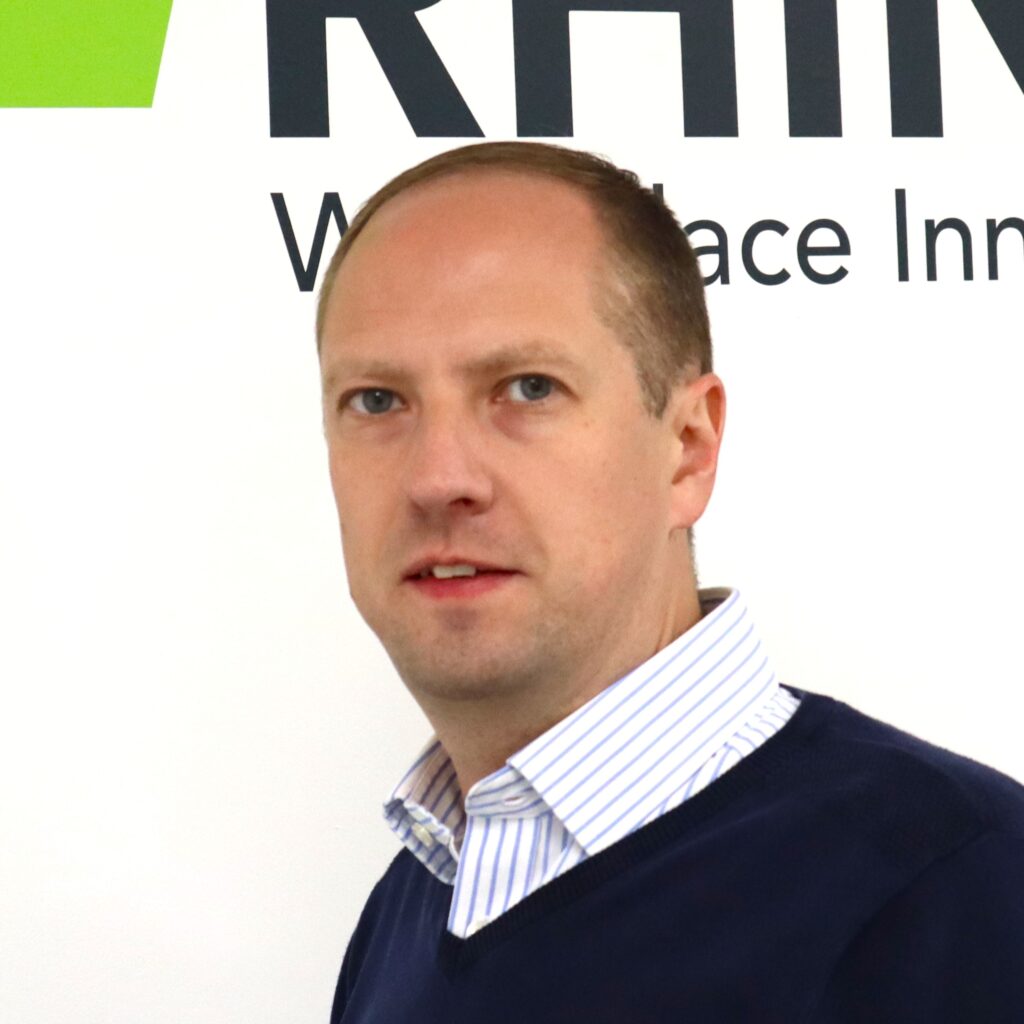
Jake Douglass, Managing Director of Rhino Workplace Innovations, makes the case for rethinking the industrial workstation, recently speaking to FM Director to explain why material selection can determine the total cost of ownership across an asset’s lifetime, and how the company’s trial model is helping FM teams make smarter specification decisions.
Ask most facilities managers to list their highest-priority assets and the workbench is unlikely to feature prominently. It’s furniture. It’s fixed. It is, in the conventional view, simply somewhere work happens. Jake has spent considerable time challenging that assumption with a compelling argument.
“A workstation is one of the most frequently used assets on the shop floor,” he said, “and its design directly influences productivity, operator safety, product quality and the lifespan of the equipment itself.” The shift he’s encouraging FM teams to make is not a minor reframe. It repositions the workstation from a line item in a capital expenditure budget into an active contributor to operational performance, housekeeping standards and continuous improvement objectives.






















Rhino Workplace Innovations supplies heavy-duty industrial workbenches alongside specialist workbench protection mats, with a particular focus on helping organisations across aerospace, automotive, advanced manufacturing, cleanrooms and education specify solutions that are genuinely suited to the demands placed on them. The company’s approach is application-led: understanding how a customer works before recommending a product, rather than the other way around.
The case for self-healing surfaces
One of the most technically distinctive elements of Rhino’s offer is its range of self-healing work surface materials, and Jake was clear about why the category matters. Traditional bench tops, particularly those made from timber or laminate, begin to deteriorate quickly under the kind of daily cutting and impact that industrial workstations routinely experience. Cuts and grooves accumulate, trapping dust, debris and contaminants, making workstations progressively harder to clean and less effective as a precision working environment.
Self-healing materials behave differently. The surface is designed to recover after each cut, closing the cut line and maintaining a consistently smoother working area over time. The downstream benefits are significant. Cutting accuracy improves, blade life extends, and the original workbench surface is protected against the kind of degradation that would otherwise trigger early replacement.
“Investing in the correct work surface can deliver a significantly lower total cost of ownership over the life of the workstation,” Jake said. For FM teams managing large numbers of workstations across multi-site operations, the compounding effect of those savings is significant. In environments such as cleanrooms, aerospace facilities and education workshops, where cleanliness and surface consistency carry regulatory as well as operational weight, the case is stronger still.
Supporting Lean Manufacturing and 5S
Many of the organisations Rhino works with have adopted Lean Manufacturing, 5S or broader continuous improvement programmes, and Jake identified the workstation as a more consequential element of those frameworks than it is typically given credit for. “A clean, consistent workstation naturally encourages better housekeeping and supports each stage of the 5S methodology,” he said.
Protective mats serve a specific function within that context: defining the working area clearly, making it easier for operators to maintain organised workspaces, identify when areas require attention, and standardise layouts across departments or across sites. Combined with heavy-duty bench structures designed to provide stable, deflection-free platforms under demanding industrial loads, the result is a workstation environment that supports visual management and efficient workflow rather than simply providing a surface.
The point Jake emphasised is that the benefit is cumulative. Small, consistent improvements made across multiple workstations can have a measurable impact on overall operational performance. For FM professionals responsible for the environments in which those improvements happen, understanding the connection between workstation specification and Lean outcomes gives the subject a strategic dimension it is rarely afforded.
Why material selection cannot be an afterthought
Different industries impose fundamentally different demands on a workstation, and Jake was direct about the consequences of getting the material specification wrong. In aerospace and composites manufacturing, the priority is clean, precision cutting surfaces that protect delicate materials and minimise contamination. Automotive and engineering environments tend to prioritise impact resistance and durability. Education workshops require versatility: surfaces capable of withstanding a wide range of activities and users without degrading prematurely.
“Selecting the wrong material can reduce productivity, increase maintenance costs and shorten the life of both the workstation and the tools being used,” Jake said. The inverse is equally true. A correctly specified surface improves operator experience, protects expensive equipment and remains fit for purpose over many years. For FM managers who may be accustomed to treating workstation procurement as a straightforward purchasing exercise, that framing represents a meaningful shift in how the decision is approached.
Rhino’s role in that process, as Jake described it, is to ensure that no customer is simply adapting their operations to suit a standard product. Every recommendation begins with an understanding of how the customer actually works.
Try before you invest
The final element of Rhino’s proposition addresses one of the more practical barriers to changing established specification habits: the difficulty of evaluating an unfamiliar product without seeing it perform in context. Jake’s response to that challenge is a trial model built around the customer’s own environment.
“We actively encourage customers to trial our products before making a larger investment,” he said. Many organisations begin with a free sample pack or a single trial mat installed on one workstation. That initial deployment allows operators, supervisors and FM teams to assess the real-world benefits directly, from improved cutting performance and cleaner workstations to operator feedback and durability over time. Once proven, the solution is typically standardised across departments or multiple sites.
Alongside the trial offer, Rhino has invested in its Innovation Centre, a facility where visitors can compare protection mats, work surface materials and workbench options in person, discuss specific applications and explore bespoke solutions with the Rhino team. The combination of hands-on demonstration and real-world workplace trial is designed to remove the uncertainty that often surrounds specification decisions. “Customers select solutions that deliver long-term value for their specific operational environment,” Jake said, “rather than simply choosing products from a catalogue.”
For FM professionals managing complex, multi-use industrial estates where workstation performance sits at the intersection of safety, productivity and compliance, that approach represents exactly the kind of informed, application-led support the market needs.
To find out more about Rhino Workplace Innovations and its range of industrial workbenches and work surface solutions, visit rhinocuttingmat.co.uk.