





By Andrew Thompson, Company Director at Skyform Ltd
Across the UK’s commercial and industrial landscape, rooftops have undergone a dramatic transformation. Driven by stringent sustainability targets and the soaring costs of grid electricity, Facilities Managers have turned millions of square meters of idle roof space into active, power-generating assets. Rooftop solar is no longer an experimental sustainability initiative, it is a critical piece of energy infrastructure.
However, this rapid decentralisation of energy generation has brought a silent, compounding operational crisis to the desks of FMs. The problem of deferred maintenance.






















Solar arrays are fundamentally passive, but they are not maintenance-free. Airborne dust, industrial pollution, bird droppings, and rainwater residue form a baked-on film that blocks sunlight. According to industry data, heavily soiled panels can suffer an efficiency drop of 25% to 50%. For an FM responsible for a multi-megawatt portfolio, that drop represents thousands of pounds in lost energy yield every single month.
Yet, despite knowing the financial consequences of dirty panels, many FMs delay cleaning. Why? Because historically, maintaining rooftop solar has required a choice between two equally unappealing options: accept a severe, ongoing financial leak, or introduce profound health and safety risks by sending human workers onto the roof.
It is time for the FM sector to rewrite this script. The future of solar asset management lies in removing human risk entirely from the equation through the adoption of advanced, remote-controlled robotics.
The True Cost of Traditional Access
For decades, the standard response to any building maintenance task at height has been to deploy traditional access methods. Whether it’s rope access, mobile elevating work platforms or temporary scaffolding, these methods rely on human boots on the ground, or more accurately, boots in the air.
When applied to solar panel cleaning, manual high-rise work creates a unique matrix of operational and safety challenges such as;
· Fall Risks and Fragile Roofs: Rooftops with large solar arrays are often complex environments. Walking between tightly packed panel rows presents an immediate slip, trip, and fall hazard, particularly when introducing water and detergent to the surface. Furthermore, navigating older commercial roofs carries the persistent threat of fragile roof structures.
· The Invisible Risk of Microcracking: When human operators use heavy telescopic poles or walk near arrays, they frequently apply uneven, localised pressure. While the tempered glass covers might look intact from a distance, manual cleaning often causes internal microcracking within the silicon solar cells. These hidden fractures permanently degrade the panel’s power output and can create dangerous electrical hotspots, turning a routine cleaning chore into an expensive liability.
· The Burden of Compliance: Managing high-risk manual work at height demands exhaustive risk assessments, method statements, and strict LOLER compliance services for lifting and safety gear. The administrative and insurance burdens alone are often enough to make FMs push solar cleaning down the priority list.
Transitioning from Manual Danger to Remote Precision
The commercial facilities management sector is rapidly moving towards automation. By replacing traditional manual labour with specialised robotic crawlers, FMs can eliminate working-at-height liabilities while simultaneously boosting operational efficiency.
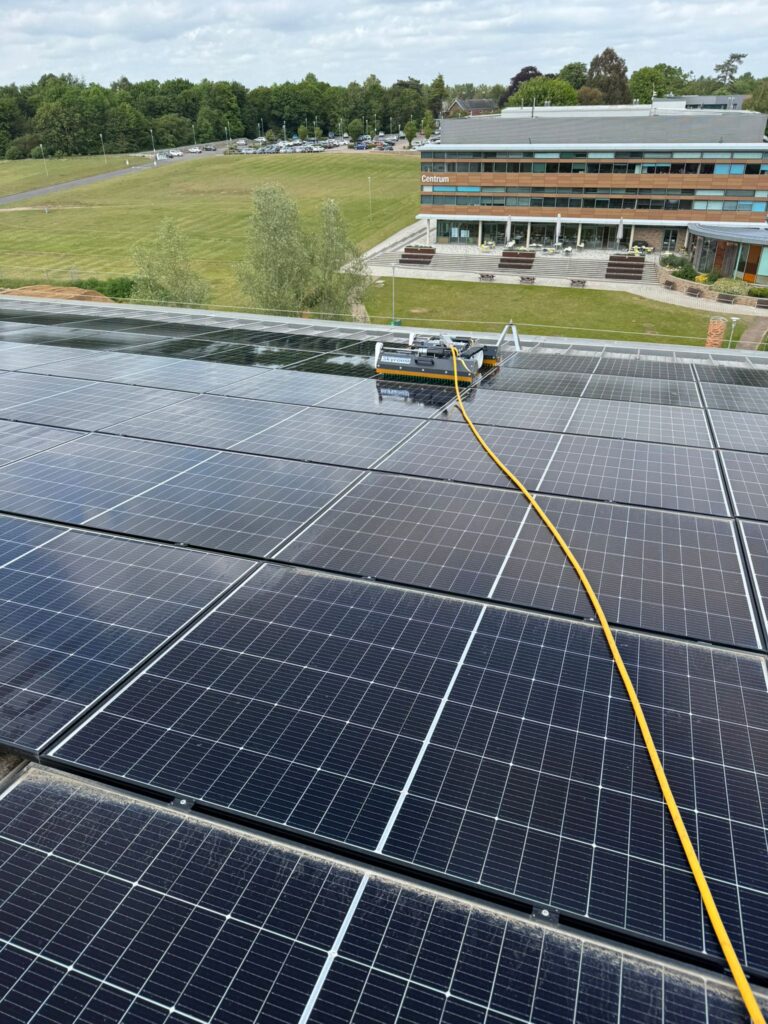
Modern robotic systems, such as the Skyform F1 and G1 cleaning robots, completely change how solar maintenance is performed. Instead of a team of workers navigating a wet, slick roof with manual tools, a single operator controls a highly precise, track-driven machine safely from the ground or a secure platform.
These robotic solutions address every flaw inherent to manual cleaning including;
1. Zero Human Exposure: By utilising remote control consoles paired with multi-angle live video feeds, the human element is completely isolated from the danger zone. No workers are sent into hazardous areas, dramatically lowering insurance premiums and eliminating the risk of working-at-height incidents.
2. Certified Panel Protection: Unlike a human worker leaning on a pole or stepping near a frame, specialised robots are engineered specifically for fragile glass environments. Operating on wide, low-pressure rubber caterpillar tracks, devices like the F1 apply a maximum pressure of just 4,200 Pa to the panel surface. They are certified through rigorous electroluminescent testing to cause absolutely zero microcracks, ensuring the structural integrity of the asset is protected.
3. Unmatched Scale and Speed: Manual cleaning is notoriously slow and weather dependent. In contrast, advanced robotic systems can clean up to 1,600 square meters per hour in both wet and dry modes, operating effectively on roof inclines of up to 27 degrees. What used to take a manual crew days to complete can now be wrapped up safely in a matter of hours.
A Strategic Shift for Forward-Thinking FMs
For FMs reading this, the takeaway is clear: solar maintenance must no longer be viewed through the lens of a reactive, high-risk window-cleaning contract. It must be treated as a data-driven component of automated asset management.
As the UK grid becomes increasingly crowded and energy prices remain volatile, maximizing the return on investment of your existing green infrastructure is paramount. However, achieving peak efficiency should never come at the expense of human safety.
By shifting from manual labour to automated, remote-controlled robotics, FMs can confidently secure maximum energy yields, satisfy stringent corporate sustainability
metrics, and ensure that their most valuable asset (their workforce), remains completely out of harm’s way. The technology to clean solar arrays safely, swiftly, and sustainably is already here.
For more information on Skyforms solar panel cleaning robots, visit https://skyform.com/facade-robotics/solar-panel-cleaning/ or call 01474 879990